Kris Longmore

To Trend or Not To Trend? (Wrong question)

Think like a trader

To Trend or Not To Trend? (Wrong question)

Someone asked me recently whether strategies based on mean reversion, trend following, and momentum are “good” or just data mining. It’s a reasonable question, but it reveals some confusion that arises from mixing up two things that sound similar but are very different. Mean reversion, trend, momentum: these aren’t edges. They’re labels for how prices

Brave New Backtest

Think like a trader

Brave New Backtest

My last two articles on AI and trading research got more engagement than almost anything I’ve written. “More of the Disease, Faster” argued that LLMs can’t answer the critical question: who pays you and why? “AI Will Create Millions of Quants” went deeper on the why: AI makes beautiful backtests trivially easy to produce, which means

AI Will Create Millions of Quants

Think like a trader

AI Will Create Millions of Quants

(Most of Them Will Lose Money) AI makes it easier than ever to build trading strategies. Prompt a model, run a backtest, optimise some parameters, and suddenly you’ve got a beautiful equity curve staring back at you. It feels like progress. It feels like research. I wrote recently about how AI coding assistants tend to

More of the Disease, Faster (What happens when you ask an LLM to find you an edge)

Think like a trader

More of the Disease, Faster (What happens when you ask an LLM to find you an edge)

This week I discovered the “vibe quant” movement (or rather, it discovered me). People using LLMs to find trading strategies, validate them, and put them into production. The pitch is seductive: the LLM reads the literature, implements the ideas, backtests them, and you just supervise. I think this approach is going to cost people a

Everything Everywhere All at Once

Think like a trader

Everything Everywhere All at Once

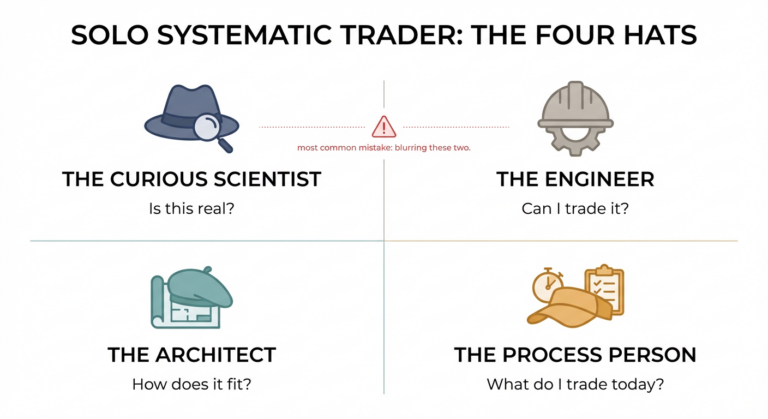
The four hats of the solo trader At a trading firm or fund, the researcher doesn’t run the execution desk. The portfolio manager doesn’t build the tech and infrastructure. These are different jobs, done by different people, with different skill sets. When you’re trading solo, you’re all of those people (and more). And the thing

The Winter of our Pairs Trading Discontent: Problems, limitations, frustrations

Trading strategies

The Winter of our Pairs Trading Discontent: Problems, limitations, frustrations

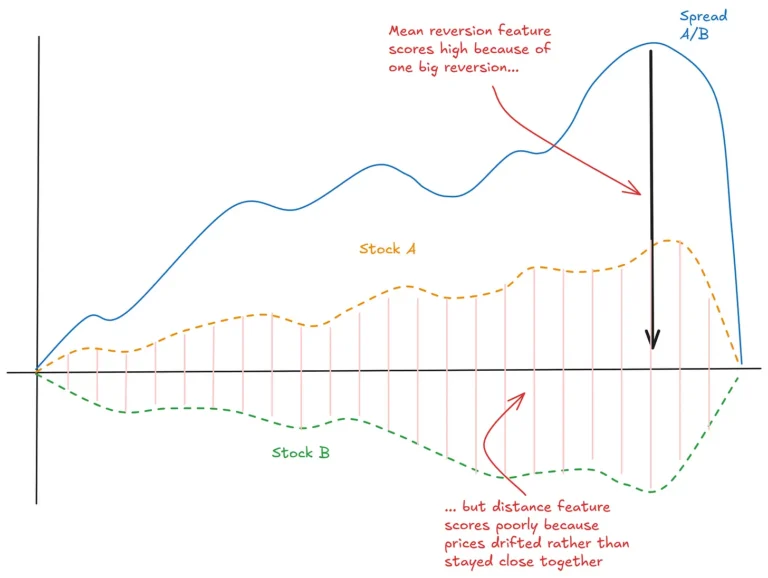
Part 3 of a series on Statistical Arbitrage for Independent Traders Previously: In the last article, we built up a conceptual understanding of universe selection: how to find pairs that diverge and converge in a tradeable way. We talked about measuring the thing you actually care about directly, rather than reaching for statistical tests like

Moneyball: Finding Undervalued Pairs Using Unconventional Metrics

Trading strategies

Moneyball: Finding Undervalued Pairs Using Unconventional Metrics

Previously: ​A Tale of Two Prices (the core idea of stat arb)​ Last time we established that stat arb is really about betting on divergence/convergence behaviour continuing. Two things that have historically moved together come apart, and you bet on them coming back together. Remember the forced flows example, some fund or whatever having to

A Tale of Two Prices

Trading strategies

A Tale of Two Prices

Part 1 of a series on Statistical Arbitrage for Independent Traders. It was the age of wisdom, it was the age of foolishness… I’ve seen heaps of stuff published online about stat arb lately. Some genuinely good takes. And some other material that, while academically interesting, isn’t particularly useful for people like me and the

Much Ado About Variance

Quant trading

Much Ado About Variance

What’s Past is Prologue Let’s be honest: 2025 was a pretty good year to be a systematic trader. If you had a diversified portfolio of risk premia, you probably did alright. Claiming we did anything overly special in such a favourable environment would be a tad arrogant. That said, there’s a big difference between “the

Trading Without Edge? That’s expensive gambling, I said…

Think like a trader

Trading Without Edge? That’s expensive gambling, I said…

When I first got interested in trading, ​The Whitlams​ were all over Australian radio, and I was making all the beginner mistakes. A big one – focusing on techniques instead of edges. I poured time and energy into building backtesting engines and frameworks for applying all the usual tools – cointegration tests, Hurst exponents, Kalman

Trading Signals in High Definition

CryptoData analysisThink like a trader

Trading Signals in High Definition

We’ve all used on/off type trading signals at some point. But you can nearly always extract more insight with a simple adjustment that focuses on using data efficiently. Let me show you how using a crypto trend example. The problem with binary signals You’ve seen them everywhere. “If price is above the 20-day moving average,

Understanding “why” beats statistical significance

Think like a trader

Understanding “why” beats statistical significance

Do you find yourself obsessing over p-values and t-stats when evaluating trading ideas? I get it. If you come from an academic or scientific background, statistical significance feels like the gold standard for determining whether something is “real” or just random noise. And in many fields, that’s exactly right. But trading is different. Statistical tests

Next

Latest RW Insider Articles