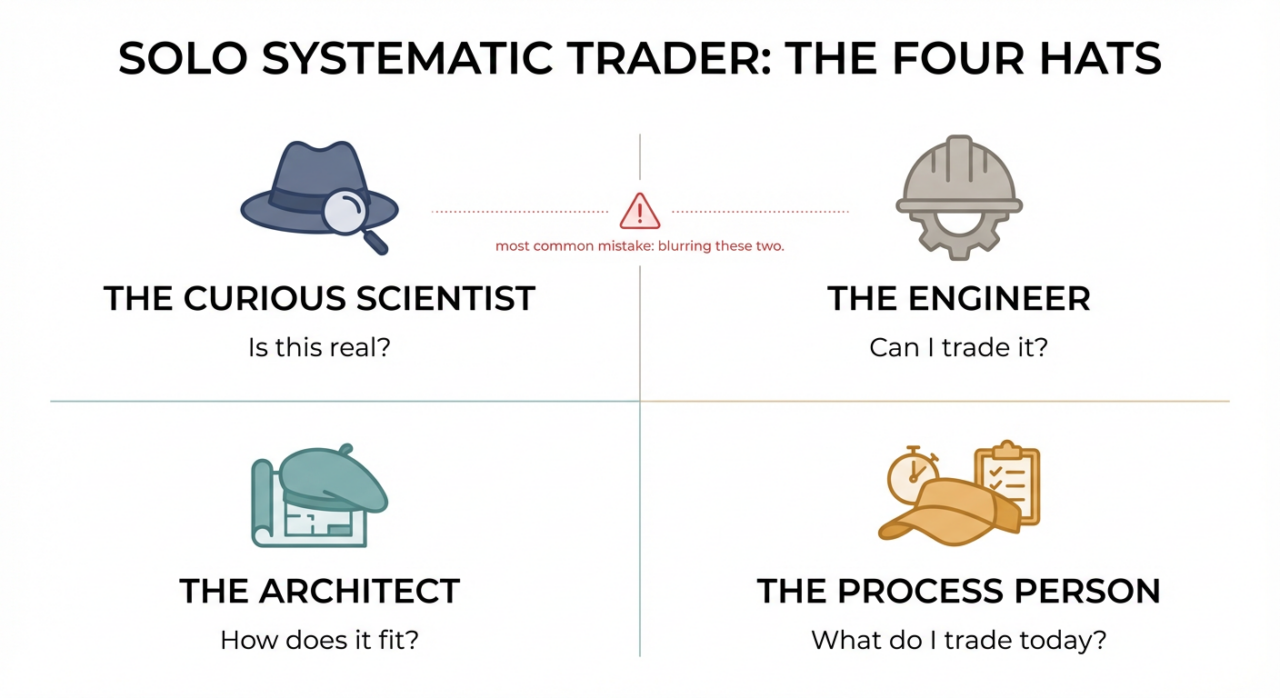
The four hats of the solo trader
At a trading firm or fund, the researcher doesn’t run the execution desk. The portfolio manager doesn’t build the tech and infrastructure. These are different jobs, done by different people, with different skill sets.
When you’re trading solo, you’re all of those people (and more).
And the thing that catches most of us is that even though you’re one person doing everything, the jobs are still distinct. They require different mindsets and different tools. When you blur them, which happens constantly when you’re doing everything yourself, you end up making a mess that’s hard to even diagnose, let alone fix.
I’ve started thinking about it as four hats. You wear all of them. But ideally, you wear them one at a time.
Hat 1: Edge Research (The Curious Scientist)
Something looks interesting in the data. You pull on the thread. You’re trying to understand a phenomenon. Is this effect real? Why does it exist? Who’s on the other side of this trade, and why are they willing to lose money?
The mindset here is pure curiosity. You’re just trying to understand.
Hat 2: Strategy Research (The Engineer)
OK, you’ve satisfied yourself that something is real. Now, can you actually trade it? What do realistic costs look like? What constraints do you face?
This is where backtesting and simulation live. And this is where most people start, which is the problem. If you start here without having done the edge research properly, you’re building on foundations you can’t possibly understand.
Hat 3: Portfolio Research (The Architect)
You’ve got a few things that work individually. How do you put them together? How much capital goes to each one? What happens when two strategies want to do opposite things?
This is where you zoom out and think about the whole portfolio. Sizing sensibly, spreading your bets, giving yourself the best chance of making money even when the future doesn’t look like the past.
Hat 4: Operations (The Process Person)
What do I actually trade today? How do I go from strategy signals to orders placed in the market? How do I track positions, reconcile, move money around, handle the daily grind?
This is the least glamorous hat. I find it the least interesting too. But it’s the one that determines whether everything else actually makes money in the real world. (Funny how that works.)
The error I see most often is blurring hats 1 and 2.
Someone spots an interesting pattern. Before they’ve understood why it exists, whether it’s stable, or what drives it, they’re already simulating a strategy around it. Optimising entry and exit rules for something they’ve noticed or theorised, but haven’t yet understood.
That’s wearing the engineering hat when you should still be wearing the scientist hat.
Think about it this way.
An engineer designing a bridge can skip straight to the design phase because the underlying physics is well understood. Gravity, material strength, load distribution. Centuries of accumulated knowledge. The research is done.
We don’t have that luxury.
When we find something interesting in the market, we understand almost nothing about it. A single chart tells us something, but the underlying dynamics, the stability, the regime dependency, all of that is still a mystery. The research phase is where you earn the right to build.
Skip it and you’re designing a bridge without knowing how gravity works.
“Will it survive transaction costs?” is a fair (and important) question. But make sure you ask it at the right time. It can wait until the science is done.
Next time you sit down to work on trading stuff, ask yourself: which hat am I wearing right now?
Scientist hat: Am I trying to understand something? Then forget about costs, position sizes, implementation details, and anything goal-oriented. Just look at the data with genuine curiosity.
Engineer hat: Am I trying to build something tradeable? Then I should already understand the effect well enough to explain it to someone in two minutes.
Architect hat: Am I figuring out how to combine strategies? Then I need to think about the whole portfolio, every strategy in context, every allocation in proportion.
Process hat: Am I figuring out what to trade today? Then I need simple, repeatable processes that I can stick with when I get bored or things get messy.
Keep them separate. Know which one you’re wearing.
It sounds simple, but honestly, I reckon it’s one of the most useful frameworks I’ve found for organising the work of trading solo.
I keep on coming back to it personally, and when I talk to other solo traders about problems they’re facing, they can nearly always solve them by switching to the right hat.
This framework is basically how we’ve organised everything at Robot Wealth.
Our Trade Like a Quant bootcamp is a crash course in the first three hats. Understanding where edges come from and how to identify them (scientist), how to test whether something survives real-world constraints like costs (engineer), and how to combine strategies into a portfolio that gives you the best chance of actually making money (architect). If you want a no-nonsense grounding in those fundamentals, that’s where I’d start.
If you’ve already got the research chops and you need help actually putting it all together and running it, that’s where RW Pro comes in. That’s the day-to-day reality of running a portfolio of strategies: what to trade today, how to size positions, how to build processes you can stick with. This year, we’re going deeper on operations than we ever have, including building out an equity statistical arbitrage strategy from scratch with members, from data analysis all the way through to live implementation.